
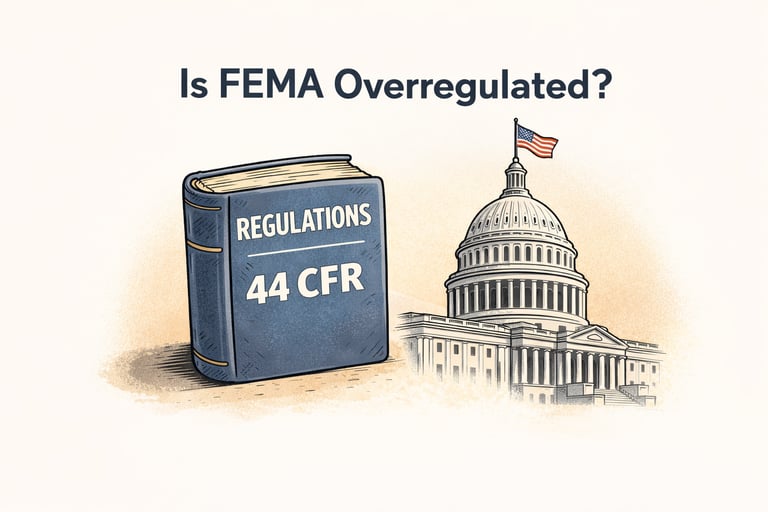
Is FEMA Overregulated?
March 13, 2026
LegReg in Brief
“FEMA is overregulated. Other agencies don't need as many rules. Why does it take so long for FEMA to act?”
That criticism of FEMA and its lawyers occurred during the March 12, 2026 legislative session at the National Emergency Management Association conference. I understand, and at times during my tenure at FEMA, I shared the frustration behind that statement.
However, the source of the complaints were from congressional staff and members of the FEMA Review Council. This is ironic given that Congress has yet to move the proposed FEMA Act across the finish line, and the FEMA Review Council’s reform recommendations still aren’t done after more than a year of work. One might reasonably ask: why is it taking so long for Congress and the FEMA Review Council to act?
It takes time because policymaking, good policymaking, is extremely difficult. And policymaking across the federal government is in significant flux right now. That reality will require acknowledgement and adaptation as the debate over FEMA reform continues.
Criticism of FEMA’s regulatory framework often assumes that regulation reflects agency preference. In many cases it reflects something else entirely: congressional ambiguity. Congress legislates in broad principles rather than operational detail. Agencies are then responsible for translating those statutes into real programs that distribute billions of dollars, withstand judicial review, and survive scrutiny from stakeholders and oversight bodies such as GAO and OIG.
However, this legal environment has changed dramatically. Courts are now demanding clearer statutory authorization for major policy decisions and are far more willing to second-guess agency interpretations.
In practice, if meaningful FEMA reform is the goal, Congress must act, and its legislation must be better than before. Statutory reforms will need to reflect a more detailed understanding of how FEMA programs actually operate.
That means there is an opportunity here. Many of the people in that legislative session, and the person writing this post, are former FEMA professionals with deep expertise in how the agency works. Most of us also believe that reforms in the direction of the agency, the delivery of assistance, and yes, the regulatory and policy process are necessary and important.
Members of Congress and the FEMA Review Council would be wise to tap into that knowledge rather than sideline it. Working together, policymakers and practitioners can draft better legislation and design more realistic reforms that will stand the test of time.
The conversation about FEMA reform is important and it should continue. But it should begin with a shared understanding of how Congress, the courts, and federal agencies interact.
LegReg in Brief
Legislation | Regulation | Implementation
← Previous | Next →


© 2025. All rights reserved.