
Shovel-Ready Recommendations: What the FEMA Review Council Should Consider
April 15, 2026
LegReg in Brief
The FEMA Review Council’s updated recommendations are expected soon. A draft from last December has already circulated. Regardless of where one lands on the Council’s direction or specific proposals, one thing is clear: FEMA has already changed, and it will continue to change. That creates an opportunity. The risk is that the Council squanders it.
Not because the recommendations are wrong. Not because they lack ambition. But because they are not implementable within the time that remains in this administration.
That is true whether you agree with the recommendations or strongly oppose them.
That is the difference between identifying problems and actually solving them.
______________________________________________________________________________
During my 20+ years at FEMA, the concept of “shovel-ready projects” stuck with me.
FEMA requires detailed hazard mitigation plans from state, tribal, territorial, and local governments. These plans are comprehensive and labor-intensive. They identify risks. They outline strategies. But they rarely produce projects that are ready to implement (i.e., “shovel-ready projects.”)
So when funding becomes available, jurisdictions scramble. Projects are not ready. Funds move slowly. Frustration builds. And the opportunity to reduce future disaster risk is lost.
That is exactly the problem with the December draft of the Council’s report. It diagnoses the issues well. But its solutions are not ready to execute. Many would take years, if not decades, to implement under current processes.
That is not a policy failure. It is a process failure.
______________________________________________________________________________
There is a recent example of what the Council should be doing instead.
On April 12, 2025, then–Senior Official Performing the Duties of Administrator Cameron Hamilton sent a memo to OMB outlining actions to “rebalance FEMA’s role in disasters.” The memo was controversial because it immediately reduced disaster funding to states.
But it got one thing exactly right: portions were immediately implementable.
Why? Because it was built with input from FEMA professionals who understand what can be done quickly, what requires more time, and what is simply not achievable within a single administration.
_____________________________________________________________________________
The Framework: How to Make Recommendations Implementable
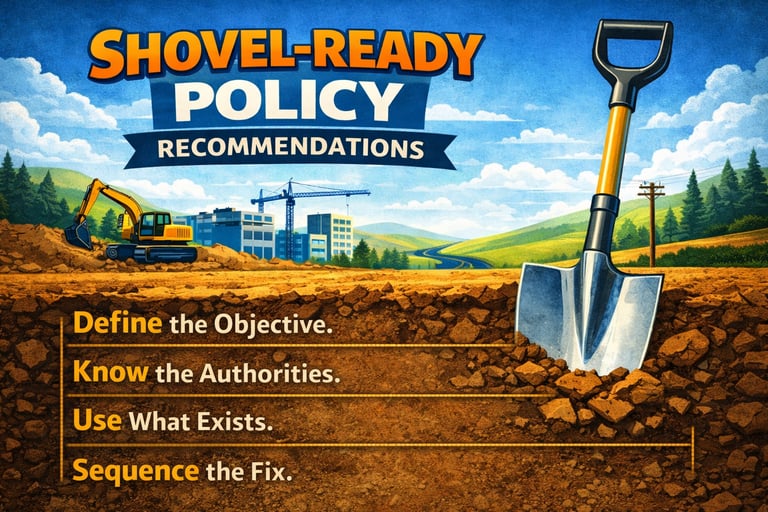
Implementable recommendations require four steps:
Define the Objective
Start with a clear, outcome-driven objective. Not an aspiration, but an operational goal. What problem are you solving, for whom, and what does success look like? A strong objective disciplines decision-making while still allowing multiple pathways forward.
Know the Authorities
A shovel-ready recommendation requires deep familiarity with the governing legal framework: statutes, regulations, and agency policy. This is not just about what the law says, but how it has been interpreted, where discretion exists, and where constraints are real.
That knowledge sits with FEMA’s program and legal experts. Excluding them guarantees that recommendations will be disconnected from reality.
Use What Exists
Before proposing new laws or regulations, identify how far the existing framework can take you. Many policy objectives can be advanced through executive action, guidance, waivers, pilot programs, or shifts in prioritization.
For example, the Hamilton memo recognized that FEMA could immediately reduce disaster expenditures by not authorizing the Hazard Mitigation Grant Program (HMGP) in new disaster declarations. Regardless of whether one agrees with that policy choice, it reflects a sophisticated understanding of FEMA’s existing authorities.
Sequence the Fix
Effective policymaking is about sequencing across time horizons. In the short term, agencies can act through policy and discretionary authorities. In the medium term, regulatory changes may be appropriate, but they should be narrow and targeted to reduce delay and litigation risk. In the long term, legislative changes may be necessary, but they must be prescriptive, clearly drafted, and structured to be implementable when the opportunity arises.
__________________________________________________________________________________
If the Council applied this framework, its recommendations would look very different from those in the December draft. They would prioritize what can be done now, within existing authorities and realistic timelines.
Regardless of whether one agrees with the Council’s policy direction, this is what implementation would require.
__________________________________________________________________________________
What This Means for the Council
Stop Chasing Legislative Fixes
At this stage, the Council should stop prioritizing recommendations that require legislation. The window, if it ever existed, has passed.
The 119th Congress is on pace to be the least productive Congress in modern history. For decades, even the least productive Congresses enacted roughly 250–300 laws. The current Congress is on pace to pass only around 140, placing it at historic lows in the post–World War II period and underscoring a broader shift away from legislative policymaking.
This is frustratingly at odds with what is currently happening in the judicial branch. As I noted in my most recent LegReg in Brief, the Supreme Court is now demanding clearer statutory authorization for major policy decisions and is more willing to second-guess agency interpretations. If Congress is failing to produce, but the Supreme Court is unwilling to accept interpretations from executive agencies, the gap ends up being filled by a small number of decision-makers within the Executive Office of the President, concentrating policymaking authority in ways that can strain the balance the constitutional structure was designed to maintain.
Even in more functional periods, agency legislative proposals are rarely enacted in full. FEMA has repeatedly transmitted comprehensive NFIP reform packages to Congress since 2017, spanning affordability, mapping, mitigation, and financing. None have been enacted as a complete package.
Even technical, noncontroversial fixes can take years. FEMA began proposing to extend Uniformed Services Employment and Reemployment Rights Act (USERRA) protections to its temporary workforce around 2010. The proposal was not enacted until 2022. The delay was not about policy disagreement. It was about timing, prioritization, and the availability of a legislative vehicle.
The implication is straightforward. Recommendations that require legislation are unlikely to produce meaningful change within any relevant timeframe.
Including them is not a path to implementation. It is, at best, signaling.
___________________________________________________________________________
Move Faster with Existing Authorities
The Council should focus on process changes that make regulatory and policy action faster and more effective.
Faster rulemaking is possible, but it requires expertise and sustained effort. From 2020 to 2025, my team increased the publication of significant FEMA rulemakings and notices by over 400 percent. One key change was reinstating an exemption from notice-and-comment rulemaking under the Administrative Procedure Act for grant programs, allowing FEMA to issue interim final rules or more comprehensively use sub-regulatory guidance for those programs.
That authority could be used immediately. FEMA could, for example, significantly streamline or remove existing HMGP regulations, allowing greater flexibility in project selection and funding.
The draft report also bemoans regulatory and administrative timelines, some of which are imposed by the Uniform Administrative Requirements, Cost Principles, and Audit Requirements for Federal Awards codified at 2 CFR Part 200. OMB is authorized to allow exceptions from these requirements for entire classes of Federal awards, recipients, or sub-recipients when the exceptions are not prohibited by statute. That authority could also be used administratively and immediately to remove bottlenecks.
The Council should also recommend reducing or eliminating DHS-level review for certain FEMA regulatory and policy actions. DHS review adds time, and FEMA’s work often competes with higher-profile priorities such as immigration. The level of review applied is not commensurate with the actual legal risk of FEMA’s grant programs.
These changes would trade some participation for speed. But the Council has already sought stakeholder input, and DHS will still weigh in on the final report. The trade-off is justified if the goal is actual implementation.
_________________________________________________________________________________
Bring FEMA Expertise Back In
The Council has engaged with DHS officials, administration leadership, and state and local stakeholders. That input is valuable. But it is not sufficient.
The draft report defines the problems and reflects stakeholder frustrations. What it lacks is the operational expertise required to translate those objectives into implementable actions.
That expertise exists within FEMA’s current and former workforce. It is unclear why it has been sidelined in decisions about the agency’s future, but the result is predictable: recommendations that cannot be executed.
The debate over FEMA’s future is important. But without an implementation strategy, even the right ideas will fail.
_____________________________________________________________________________
There are ways to accomplish many of the Council’s stated objectives within existing authorities and realistic timeframes. I have outlined several process improvements here that could move those objectives forward. In several instances, the Council identifies objectives but assumes they require legislative change or leaves implementation unaddressed, even where existing authorities provide a path.
But, hey, I can’t give away the farm (or the shovel) 😊.
If you’re serious about shovel-ready recommendations, hire The McGregor Group. Our team includes some of FEMA’s most experienced operators who have led and executed change from the inside.
© 2025. All rights reserved.