
Elephants in Mouseholes: The Major Questions Doctrine and the End of Chevron
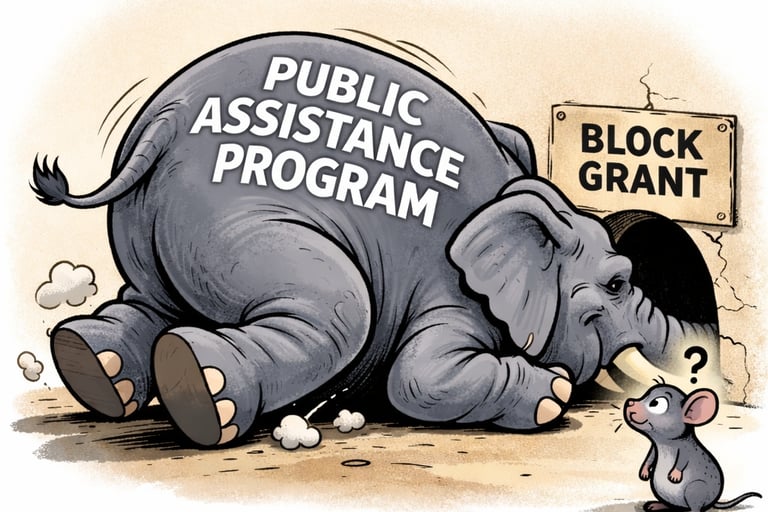
Case Study: Only Congress Can Fit the PA Elephant into the Block Grant Mousehole
March 25, 2026
LegReg in Brief
The future of FEMA and emergency management has been the subject of intense debate since the beginning of 2025. In practical terms, FEMA has already undergone significant change. Approximately 2,500 FEMA employees, including senior leadership, departed the agency between January and mid-2025, representing roughly 10% of its workforce. A directive that required DHS approval for all grant or contract awards in excess of $100,000 has created bureaucratic gridlock, introduced significant operational challenges and hampered critical missions. FEMA has also canceled or delayed key grant programs prompting litigation. In short, the FEMA of 2025 bears little resemblance to the FEMA of 2024.
This is not unique to FEMA. Across the executive branch, agencies have experienced rapid change, though to varying degrees. The long-term consequences of this will be measured in decades, as the country decides whether to accept a diminished executive branch, or to rebuild it.
What is less widely understood is the landscape in which this started to happen. The current moment is not simply the product of policy choices. It is also the result of a fundamental shift in administrative law, and a growing skepticism of broad agency power, formalized by a series of Supreme Court decisions beginning in 2022.
Now, what cases am I talking about? The first is West Virginia v. EPA, 597 U.S. 697 (2022), which dealt with the Environmental Protection Agency’s attempt to regulate greenhouse gas emissions from power plants by encouraging a shift away from coal toward cleaner energy sources. This effort did not originate in 2022; it followed years of regulatory whiplash between administrations. The Obama Administration sought to transform the electricity sector through system-wide emissions limits, but the Trump Administration reversed course and confined EPA to regulating individual plants. When the Biden Administration signaled a return to broader authority, the Court stepped in. The Court held that for issues of “vast economic and political significance,” agencies must point to clear congressional authorization before acting. This principle, now known as the “major questions doctrine” reflects a long-standing skepticism of broad agency power. This did not originate in 2022; as early as 2001, Justice Scalia espoused this view, writing that Congress does not “hide elephants in mouseholes.”
The second case is Loper Bright Enterprises v. Raimondo, 603 U.S. ____ (2024), which dealt with the National Marine Fisheries Service’s regulation requiring fishing companies to pay for government monitors placed on their boats. It arose under the Magnuson-Stevens Act which explicitly required fishing companies to pay for observers in certain fisheries, while remaining silent as to others. NMFS interpreted the silence, combined with its general regulatory authority, to allow it to impose the same requirement across fisheries, effectively treating the absence of authorization as a gap it could fill. The Court found against NMFS, and used the opportunity to overrule Chevron U.S.A. Inc. v. Natural Resources Defense Council, Inc., 467 U.S. 837 (1984). Chevron established the principle that courts must defer to reasonable agency interpretations of ambiguous statutes. For decades, Chevron has enabled Congress to legislate in broad terms, and for agencies fill in the gaps.
So, what does this mean? As I stated in my March 13 LegReg In Brief, it means that courts are now demanding clearer statutory authorization for major policy decisions and are far more willing to second-guess agency interpretations. My clients at FEMA recognized that a shift was occurring, but it was difficult at the time to predict how the case law might play out in practices. When they asked me how it might affect their day-to-day work, the only answer I was able to confidently give was “Now, more than ever, you’re going to have to make and defend your policy choices based on the clearest and best reading of the statute for your program.” What I did not say, because it would have required a detour into administrative law that only lawyers truly appreciate, was that they shouldn’t hide elephants in mouseholes.
That advice has held up; in fact, it is truer today than when I first gave it in 2022. Since West Virginia v. EPA, the major questions doctrine has been invoked in hundreds of cases and has become a standard feature of challenges to federal actions. It may not decide every case, but it is not fading. The doctrine is being rapidly and thoroughly tested in litigation. The death of Chevron, on its own, has had a more limited felt impact. Even before Loper Bright, the Supreme Court had largely stopped applying Chevron in practice, although lower courts used it routinely. The Loper Bright decision did not so much change course as formalize a shift already underway, replacing deference with judicial independence in interpreting statutes.
The combination of the major questions doctrine and the death of Chevron, however, fundamentally changes reliance on agencies. Previously, if there was ambiguity in a statute, and an agency had adopted a reasonable interpretation, the agency would prevail in a legal challenge. Now, if there is ambiguity in a statute and the stakes are high, the agency is likely to lose. In effect, ambiguity no longer expands agency authority; in the most important cases, it constrains it.
How does this affect actual agency decision-making? Consider a case study: FEMA’s Public Assistance (PA) program. One of the most frequently proposed reforms is to convert PA, its largest program, into a block grant.
The appeal is straightforward. A block grant model promises faster funding, greater state flexibility, and fewer federal requirements. In theory, funds could be distributed based on a formula, allowing states to move more quickly to recover from disasters without navigating the complexity of a project-by-project reimbursement system.
What does the statute say about the PA program? Does it authorize a block grant program? The fast answer is "no," but the details matter. PA is not an open-ended funding stream. It is a detailed statutory program grounded in the Stafford Act, which specifies: (a) the types of work that are eligible for assistance; (b) the conditions under which funding is provided; and (c) the federal role in reviewing and approving projects. In other words, the “elephant” is built into the statute.
In contrast, a true block grant provides upfront, formula-based funding with broad discretion for the recipient to allocate funds across activities with minimal federal project-level oversight. For example, the Community Development Block Grant (CDBG) program provides formula-based funding directly to state and local governments. (Notably, “block grant” also appears in the title.)
As relevant to this conversation, Congress has already experimented with a block grant-like structure within the PA program. Section 428 of the Stafford Act allows for fixed-cost estimates and provides recipients with greater discretion in how projects are completed, including the ability to retain cost savings. But importantly, Section 428 does not convert PA into a block grant; it only offers states a choice. Section 428 specifically prohibits FEMA from requiring states to use Section 428, and states have been reluctant to use it as they view the certainty of FEMA reimbursement as the better deal.
This means Congress would need to act to convert PA into a block grant program. This is not unknown; the FEMA Review Council recognized in its Dec. 11 draft report that congressional action would be required to durably convert PA into a block grant. The challenge is that Congress remains deadlocked and polarized, and has struggled to advance comprehensive FEMA reform. Will the Executive Branch be willing to wait the requisite amount of time for Congress to act? The answer is likely "no" since the executive branch has chosen time and time again to prioritize speed over legal durability or public participation.
Could FEMA pursue more incremental changes that push against statutory boundaries? One could imagine pressure to reinterpret or narrow existing constraints in ways that move the program closer to a block grant model without formally redesigning it. Those approaches raise the same underlying question: how far can statutory interpretation be stretched before it breaks?
That shift matters most when agencies attempt to reinterpret statutes to support new policy directions. In the past, ambiguity created room for agencies to change course and still receive deference from courts. Today, that same ambiguity is a liability. Without Chevron, and with the overlay of the major questions doctrine, reinterpretation is far less likely to survive judicial review.
Against that backdrop, an administrative effort to convert PA into a block grant would likely face significant legal obstacles. It would represent a major shift in federal disaster policy, and the Stafford Act does not clearly authorize it. Even without relying on the major questions doctrine, that combination is likely dispositive. As Justice Kagan recently stated in a major questions case, “straight-up statutory construction resolves this case for me; I need no major-questions thumb on the interpretive scales.” But in practice, litigants will not leave that thumb off the scale. The major questions doctrine will almost certainly be invoked as well. Administrative re-tooling is unlikely to provide a durable foundation for long-term reform.
The pressure to act will remain. The incentives to move quickly will only grow. But under the current legal framework, speed cannot substitute for statutory authority.
Because if there is an elephant in FEMA’s future, Congress will have to put it there. It will not be found in a mousehole.
LegReg in Brief
Legislation | Regulation | Implementation


© 2025. All rights reserved.